What Grade of Gravel Works Best for Your Driveway?
If you’ve started shopping for a gravel driveway along the Front Range, you’ve probably run into more options than you expected. Road base, crushed gravel, river rock, breeze material, different colors, different sizes. It’s a lot to sort through, and most of the advice you’ll find online is either too generic to be useful or written by someone who has never actually stood on a driveway watching it fail.
I’ve built and repaired enough gravel driveways in Boulder County to have strong opinions on this, and most of them come from watching what happens after the truck leaves and the driveway has to survive a Colorado winter, a steep grade, or daily traffic. Here’s what actually works.
The Two Layers That Make a Driveway Work
A proper gravel driveway isn’t just one layer of rock dumped and spread. It’s a system, and the system only works if both layers are doing their job.
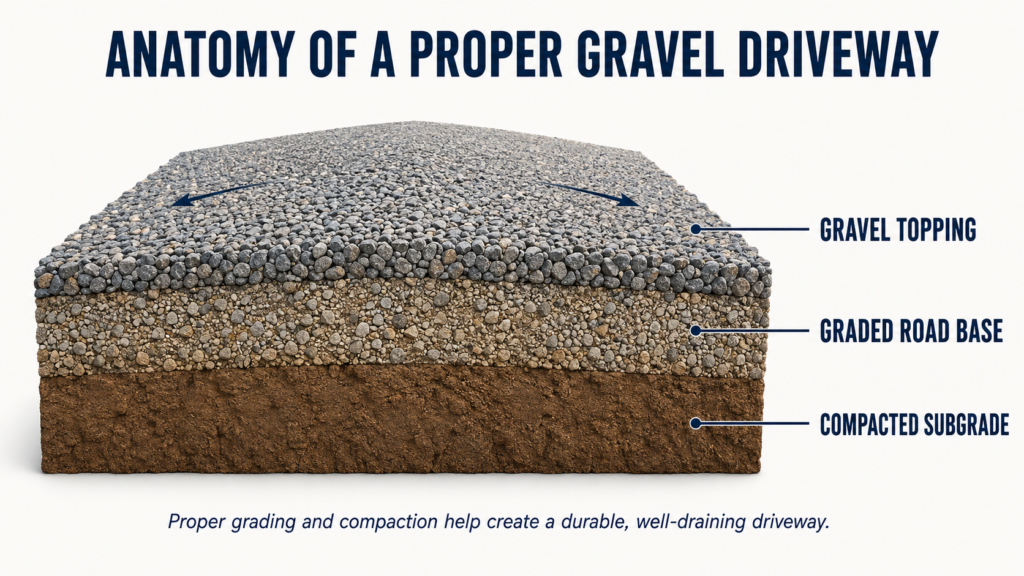
The bottom layer is your road base. This is the structural layer that gives the driveway its strength and stability. The top layer is what you actually see and drive on, and for most residential driveways on the Front Range, that should be three quarter inch crushed gravel.
Skip either layer, or get the wrong material in either layer, and you end up with a driveway that looks fine for a season and then starts giving you problems.
Matching Your Road Base to Your Gravel
One detail that a lot of people don’t think about until it’s too late is color coordination between the road base and the top layer. Road base comes in a few different types, and they aren’t the same color.
Straightforward road base is a natural reddish tone. Class six road base is recycled concrete and comes out light gray. Asphalt road base is dark gray to black.
My recommendation is to choose your road base color based on what your finished driveway is going to look like on top. If you’re going with a darker gravel or a black granite finish, you want a road base that’s going to coordinate with that rather than clash with it. It’s a small thing, but it’s the kind of small thing that separates a driveway that looks intentional from one that looks like it was thrown together.
Why Three Quarter Inch Crushed Gravel Is the Standard
For the vast majority of residential driveways, three quarter inch crushed gravel is what I recommend, and there’s a real reason behind it, not just habit.
Crushed gravel has angular edges. When you compact it, those edges lock together and create a surface that stays put. That’s the whole ballgame with a gravel driveway. You want a surface that resists shifting under tires, that doesn’t wash out in a downpour, and that doesn’t turn into a mess of loose stone within a year.
River rock and pea gravel don’t do this. They’re rounded, which means they roll instead of lock. You can compact them all day and they’ll still shift under your tires, especially anywhere there’s a slope or a turning radius. I don’t recommend either one as a driving surface, no matter how good they look in photos. They’re better suited for landscaping beds than for something you’re going to drive a car over every day.
A Driveway That Taught Me This the Hard Way
I worked on a project not long ago where the neighboring property had put down a dark breeze material on their driveway. It looked great when it went in. Dark, clean, uniform color.
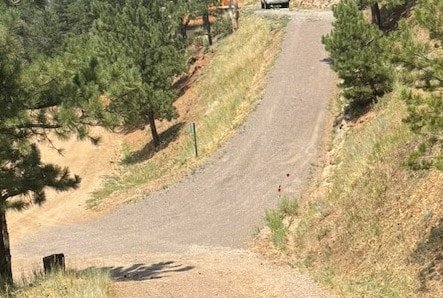
The problem was the driveway had a steep grade, and there was no three quarter inch aggregate anywhere in that mix. It was almost entirely fine material. Fine aggregate doesn’t compact and lock the way crushed gravel does. There’s nothing for it to grab onto. So even after it had been rolled and compacted, the surface stayed loose and slippery, especially going up or down that slope. Steep grades like this one show up a lot in the foothills, and they come with their own set of problems beyond just gravel grade. I get into that more in what’s actually wrong with your Boulder County mountain driveway.
That driveway is a good example of why grade matters more than color or appearance. It looked like a premium finish, but functionally it was a driveway that was going to be a problem every time it rained or snowed. Three quarter inch crushed gravel avoids that because the larger stones give the material something to interlock with. That’s not a preference on my part, it’s just how the physics of compaction works.
When You Need Something Bigger Than Three Quarter Inch
Three quarter inch crushed gravel is the right call for normal residential use, daily cars and trucks coming and going. It holds up well and wears evenly over time.
Where I’ll recommend something different is when a driveway or yard is regularly dealing with heavy equipment. Farmyards, equipment yards, anywhere machinery is coming and going on a daily basis, that’s a situation where I’ll spec an inch and a half crushed gravel instead. The larger material has more strength and holds up better under the kind of extreme point loads that heavy equipment puts on a surface. A three quarter inch mix can start to break down faster under that kind of weight.
So the short version is this. For a normal home driveway, stick with three quarter inch. For a farm or a working equipment yard, size up to an inch and a half.
Don’t Underestimate Color Consistency
Grade and size get most of the attention, but color consistency is something I push customers on just as much, especially when we’re doing a repair or an addition to an existing driveway.
The Front Range has a good range of gravel colors and blends available, so in most cases we can get pretty close to matching what’s already down. When we can’t get an exact match, I steer people away from just adding a noticeably different color into the mix. What happens is you end up with what looks like two separate driveways sitting side by side instead of one continuous surface. It reads as a patch job even if the material itself is fine.
The driveways that look best years down the road are the ones with an even, consistent tone across the entire surface. That’s worth prioritizing over trying to force an exact color match that might not be available.
The Bottom Line
If you’re putting in or repairing a gravel driveway on the Front Range, here’s what I’d tell you if you called me directly.
- Use a proper road base underneath, chosen to coordinate with your top layer.
- Use three quarter inch crushed gravel for the driving surface on a standard residential driveway.
- Avoid river rock and pea gravel as a top layer if you actually want a stable surface to drive on.
- Step up to an inch and a half crushed gravel only if you’re dealing with regular heavy equipment traffic.
- Keep your gravel color consistent across the whole surface, even if that means not chasing an exact match.
Grade matters more than most people realize when they’re picking out gravel. It’s easy to focus on color and price and overlook the fact that the size and shape of the stone is what determines whether your driveway holds up or turns into a maintenance headache. I’ve seen both outcomes up close, and it usually comes down to this one decision.
If your driveway is already showing signs of trouble, whether that’s ruts, washboarding, or gravel that keeps migrating to the edges, it’s worth reading when you should repair your gravel driveway before you decide whether a full regrade or a simple top-up is the right move.
If you want a second opinion on what your driveway needs, Front Range Driveway and Gravel is happy to take a look and walk you through the options that make sense for your property. Give us a call at 720-303-1434.