Water Is Always the Problem
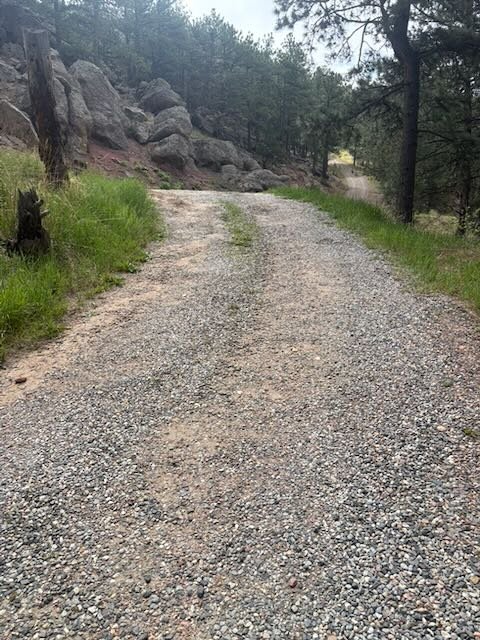
Every driveway problem we encounter in the foothills comes back to water. It just shows up wearing different disguises. Potholes, washboards, ruts, gravel that keeps disappearing, edges that keep collapsing. All of it traces back to water that isn’t moving the way it should.
The tricky part about mountain driveways specifically is that the water doesn’t always come from where you think it does.
We had a job recently on Lee Hill Road where the homeowner had been fighting a chronic washout problem in the middle of his driveway for years. He had tried adding gravel multiple times and it kept washing away. When we walked the property together, we could see that water from the road was draining off the shoulder and running parallel to the road until it hit his driveway. Because his driveway ran downhill from that point, the water was turning and funneling straight down the center.
He had never really thought about the road as part of his problem. Once we traced the actual flow path together, he could see it immediately. His neighbor’s runoff was compounding on top of his own drainage and concentrating the flow right at his most vulnerable point. The fix wasn’t more gravel. It was a pair of small diversions that interrupted the flow before it could build momentum. The driveway has held up since.
This kind of compounding flow issue is common in the foothills and it rarely gets diagnosed correctly because homeowners are looking at their driveway, not at everything uphill from it.
Why Mountain Driveways Take a Much Harder Beating
If you have a property in the mountains and you compare notes with someone out in Erie or Longmont, your driveway maintenance costs are going to be higher and your repair cycles are going to be shorter. That’s not bad luck. It’s physics.
The tree canopy is a big part of it. Out on the plains, a sunny day in March can melt a foot of snow in a matter of hours. That water moves fast, it’s somewhat predictable, and it’s over quickly. Up in the foothills under a heavy canopy, that same foot of snow might take a week or ten days to fully release. The melt is slow, constant, and prolonged. Your driveway is dealing with sustained water flow for days at a time instead of hours.
Add to that the north-facing slopes that see almost no direct sun. Some sections of mountain driveways stay frozen or partially frozen well into spring while the rest of the driveway is thawing and softening. That uneven freeze-thaw cycle creates weak spots that fail under traffic before you even realize they’ve developed.
Then there’s the terrain itself. A typical mountain driveway might have two or three turns, a couple of steep pitches, a low point, maybe even a seasonal drainage crossing. Each one of those features is a potential failure point. And each one needs to be understood and addressed differently.
We see driveways where the road was graded away from a cliff edge for obvious safety reasons, which makes complete sense, but that grade works against the drainage. The water has nowhere to go except down the driving surface. Solving that kind of problem means understanding the full picture and finding solutions that work for both safety and water management at the same time. It is never one size fits all.
The Most Common Thing Homeowners Get Wrong
When we show up to a mountain driveway that has been struggling for years, the homeowner almost always says the same thing: “I’ve had gravel brought in a few times but it just keeps washing away or disappearing.”
That gravel isn’t disappearing. It’s either washing out because the drainage problems that caused the erosion in the first place were never fixed, or it’s getting pressed down into the subgrade because the existing material was never properly redistributed and compacted before the new gravel went on top.
Gravel on top of an unaddressed drainage problem is expensive and temporary. You’re filling a bucket that has a hole in the bottom.
What surprises a lot of our clients is that many driveways don’t need new gravel at all. The material is already there. Over years of traffic and weather, it gets pushed to the edges, buried under fine particles, or compacted unevenly. A proper maintenance pass with the right equipment can pull that material back into position, rebuild the crown, and compact everything so it locks together. The result looks and performs like a driveway that just had fresh gravel put down, without the cost of the material or the delivery.
We’ve done jobs where the homeowner was fully prepared to spend several thousand dollars on a gravel delivery and we’ve been able to restore the driveway without bringing in a single yard of new material. That’s not always possible, but it happens more often than most people expect.
The Failure Points Every Mountain Homeowner Already Knows
Here’s something we’ve found to be universally true. Every homeowner knows exactly where their driveway is failing. They drive over it every day. There’s a bare streak across a steep section where the gravel keeps kicking out. There’s a low spot that turns into a mud pit every spring. There’s a corner that washes out after every hard rain.
These aren’t mysteries. They’re predictable failure points, and most of them come down to a combination of steep grade, high traffic concentration, and inadequate drainage.
Steep sections and curves are the hardest areas to maintain on any mountain driveway. Tires accelerating or braking on a grade displace surface material in ways that flat sections never experience. Once the gravel starts to thin at those points, water finds the weakness and accelerates the damage. Washboards are one of the most common results — and one of the most misunderstood. If you’re seeing corrugation on your driveway, it’s worth understanding what actually causes washboards and why most repairs don’t stick.
Addressing these spots well requires looking at both the grading and the drainage before deciding on a repair approach. Sometimes re-grading to shift the water path even a few inches makes a significant difference. In more severe cases, especially where the grade is steep and the traffic is consistent, geogrid is worth serious consideration. Geogrid installed beneath the surface gravel holds the material in place far more effectively than compaction alone. It’s an intervention that adds cost upfront but dramatically reduces how often that section needs attention.
Speaking of compaction, it is the single most essential element of a driveway repair that lasts. You can do everything else right and if you don’t compact properly, the surface will start to degrade almost immediately under traffic. Proper compaction is what locks the material together and gives the driveway its structural integrity. It’s also the step that a lot of informal driveway work skips entirely, which is a big part of why so many mountain driveways seem like they need constant attention.
Why People Wait Too Long and What It Costs Them
The most common thing we hear at the end of a job is some version of “I can’t believe I waited this long to do this.”
It happens almost every time. People drive over the same ruts and washboards for years. They get used to it. It becomes the normal that they just live with. And then we show up, spend an hour or two, and the driveway looks and drives like it did when it was first put in. The reaction is almost always the same combination of relief and frustration that it took so long to get there.
The honest truth is that driveways don’t need to get to a bad state before they’re worth maintaining. Think about how you approach your lawn or your landscaping. You don’t let it go completely to weeds for three years and then do a massive renovation. You do periodic maintenance and it stays in good shape with a lot less effort and expense over time.
Gravel driveways work the same way. A maintenance pass every couple of years, timed right, keeps the crown intact, keeps the edges from migrating, and keeps the drainage working the way it should. Catch it before it gets bad and the job is fast, affordable, and the results last. Wait until it’s compounding failures on top of each other and now you’re looking at a full restoration, possible material costs, and a longer day. If you’re not sure where your driveway falls on that spectrum, this breakdown of when to repair a gravel driveway in Colorado will help you read the signs before they get expensive. You can see the full range of our gravel driveway restoration and maintenance services to get a sense of what the right approach looks like for different driveway conditions.
The driveways that hold up best over time are the ones where the owner treats maintenance as a routine rather than a reaction.
Ready to Stop Fighting Your Driveway?
If your driveway is showing any of the problems described here, we work throughout the Boulder County foothills and we can usually tell you within the first few minutes of looking at it exactly what’s going on and what it will take to fix it. Call or text 800-808-1624.
1 thought on “What’s Actually Wrong With Your Boulder County Mountain Driveway (And Why More Gravel Isn’t the Answer)”