What Are Washboards And Why Do They Keep Coming Back?
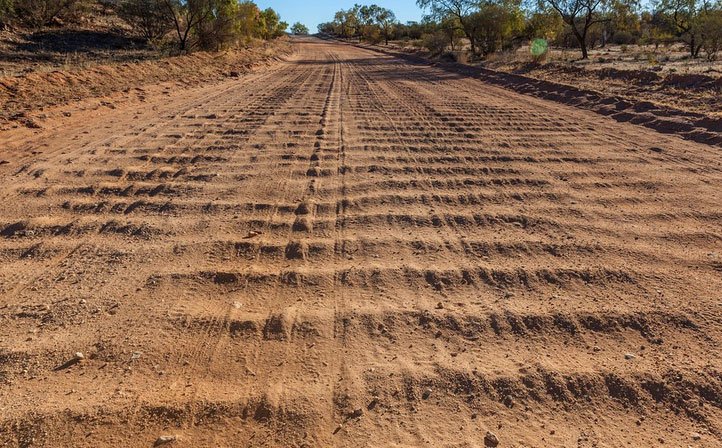
If you’ve ever driven down a gravel driveway that felt like a rumble strip, you’ve experienced washboards. That repeating corrugated pattern that rattles your teeth and shakes your vehicle is one of the most common complaints I hear from Boulder County homeowners, and it’s also one of the most misunderstood.
Most people assume washboards just happen with age or heavy use. The real cause is more specific than that, and understanding it is the first step toward actually fixing it for good.
What Actually Causes Washboards in the First Place
Washboards are created by vehicles accelerating or decelerating on a loose gravel surface. Here’s the mechanics of it: a car’s suspension hits a small bump or irregularity, and for a brief moment the tire loses contact with the surface. When it comes back down, the wheel presses into the gravel and pushes a small ripple forward. That happens again at the next bump, and the next, and over time those small ripples propagate into a full corrugated wave pattern across the entire surface.
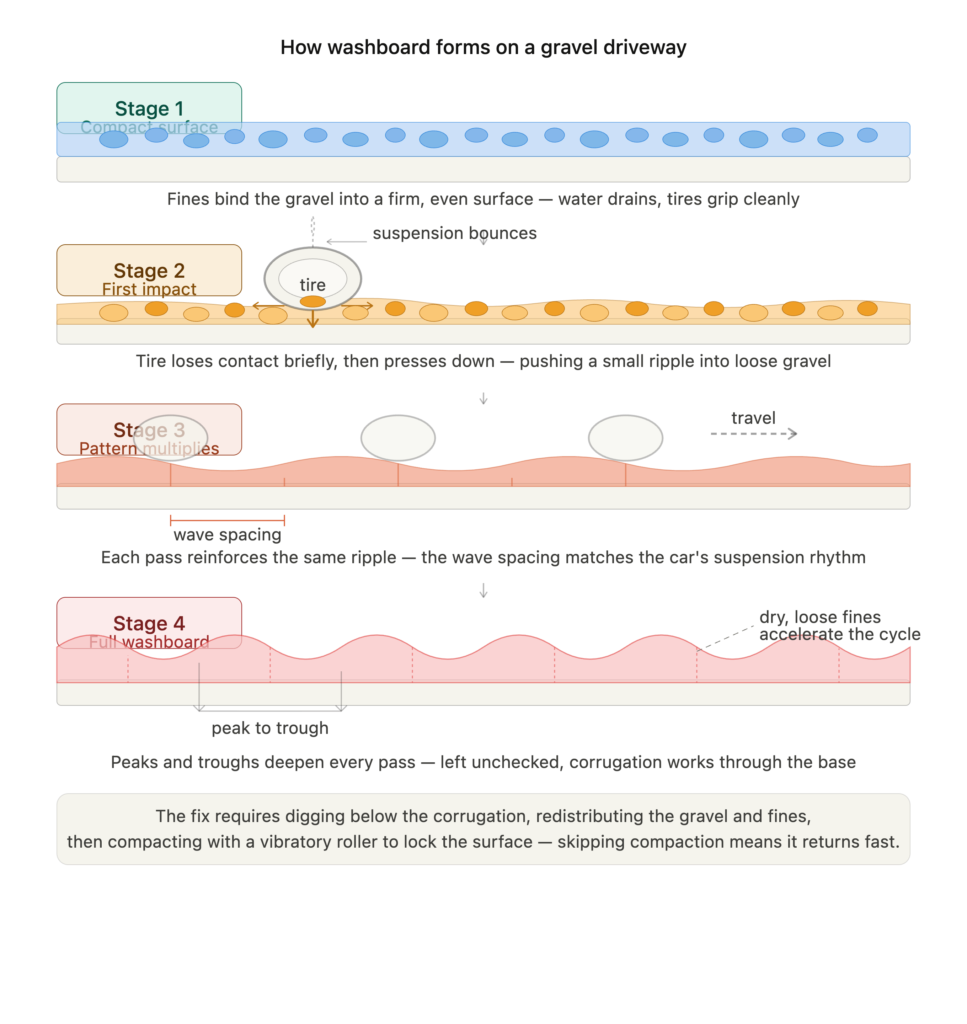
Dry conditions make it significantly worse. The fines in a gravel surface act as a binder. When moisture is present, those fines hold the surface material together and give it some rigidity. When the surface dries out, that bond weakens, gravel gets pushed around more easily, and the fines get compressed further into the base. Then when precipitation does arrive, water can’t drain correctly through the compacted layer, which causes deeper erosion and accelerates the whole cycle.
This is why washboards are a downward spiral. It doesn’t plateau. Left alone, it grows in width, depth and length until it stops being a surface problem and becomes a base problem.
The Right Way to Fix Washboards
I want to be straightforward about something before going further. There is a correct way to fix washboards and there are a lot of half measures that feel like fixes but aren’t. I’ll get to those in a moment. First, here’s what a proper repair actually involves.
Step One: Dig Out Below the Corrugation
You can’t fix washboards by working on top of them. The corrugated pattern extends down through the surface material and into the compacted fines below. A proper repair starts by getting below all of that with a power rake, digging out the entire affected section to reset the surface from scratch.
Step Two: Redistribute and Re-Grade
Once the washboard has been broken up and the material loosened, the power rake redistributes the gravel and fines back across the surface evenly. This is where the skill of the operator matters. You’re not just moving material around. You’re re-establishing the correct grade and crown so water will drain off the surface the way it’s supposed to.
Step Three: Compact — This Is the Step That Actually Matters
This is where most DIY repairs and a lot of contractor repairs fall short. After the surface has been raked and redistributed, it has to be compacted with a vibratory roller. The roller locks the gravel and fines together into a solid, stable surface that resists the tire pressure that caused the washboard in the first place.
Without this step, everything done before it is temporary. A loose, uncompacted surface will begin showing the same washboard pattern almost immediately. I’ve seen driveways that were raked and left without compaction develop visible corrugation within a few weeks. The compaction phase is not optional. It is the repair.
When Washboards Go Deeper Than the Surface
Most washboard problems on Colorado driveways can be solved with the dig, redistribute and compact sequence described above. But there’s a subset of situations where that isn’t enough, and they’re more common here in the foothills than people realize.
On steep driveway sections, vehicles have to get on the gas to make it through. That acceleration puts intense, repeated downward and forward pressure on the surface in the same spots every single time. Even a properly compacted surface can develop new corrugation quickly in those sections because the forces involved are just too consistent and too strong.
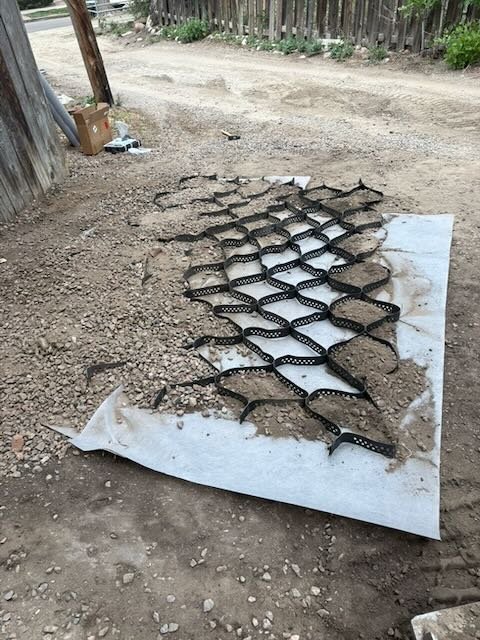
In those cases, we use geogrid beneath the surface material. Geogrid is a structural layer that contains individual cells which hold the gravel in place horizontally and prevent it from being pushed into the washboard pattern by tire pressure. It’s not a product most homeowners have heard of, but it’s the difference between a repair that holds on a steep grade and one that has to be redone every season.
What Happens When You Let Washboards Go Too Long
This is the part of the conversation I have most often with homeowners who have been putting off the repair. Washboards do not stabilize on their own. It gets worse in every dimension simultaneously, growing deeper, wider and longer with each rain event and each vehicle pass.
At a certain point, the corrugation works its way through the gravel surface and down through the road base to the subsurface below. When that happens, you’re no longer looking at a maintenance repair. You’re looking at a full base rebuild, which means excavating the damaged section, installing new base material, compacting it in layers, and then re-graveling and compacting the surface on top of all of that.
The cost difference between catching washboard early and letting it reach the base is significant. A surface repair is a fraction of the cost of a base rebuild. The math on acting early is not complicated.
Beyond the cost, there’s the daily reality of driving over serious washboard. It damages vehicles over time. It makes every trip in or out of your property uncomfortable. And it never gets better on its own.
There is no other road condition more universally despised than the washboard, and with good reason.
Why DIY Washboard Repairs Usually Don’t Stick
I want to give homeowners a fair answer here because I know a lot of people have tractors or even skid steers and want to handle things themselves. The digging and redistribution part of a washboard repair is something a capable operator can do with the right equipment. That part is achievable.
The compaction part is not. Proper compaction requires a vibratory roller, and that’s not a piece of equipment most homeowners have access to. A tractor with a box blade or a hand rake can move material around, but neither one can lock the surface together the way a roller does.
The result is a driveway that looks better for a few weeks and then develops the same washboard pattern again. If you find yourself raking your driveway twice a year and wondering why it keeps coming back, the missing step is compaction. Doing the full repair correctly once costs less over time than doing an incomplete repair over and over.
What to Do If You Have Washboards Right Now
If you’re seeing corrugation on your driveway, here’s how to think about it:
- If it’s shallow and the corrugation is only in the top inch or two of gravel, you’re in good shape for a straightforward surface repair
- If it’s deep enough that you can see exposed base material or soft spots in the corrugated sections, the repair is more involved and you should get an assessment before assuming it’s a simple fix
- If you have a steep section that keeps developing washboards no matter what you do, geogrid may be the right long term solution
- If the washboard has been there for more than one full season without being addressed, get someone out to look at the base before assuming it’s still a surface problem
The best time to fix washboard is the first time you notice it. The second best time is right now.
If you’re in Boulder County and you’re not sure how deep the damage goes or what kind of repair you’re actually looking at, I’m happy to take a look and give you a straight answer.